SMAAT · Notification Channels

Push, email and SMS for survey prompts

Each notification schedule can deliver its prompt as a push notification, an email or an SMS (text message). The schedule defines which channels are used, in which order, and whether they are sent together or one after another.

Push SMS
PARTICIPANT
The model

Each prompt passes three checks before delivery

The schedule names the channels. For every participant, SMAAT then checks whether each channel can reach that person and whether the current time falls into the participant's quiet time. A channel that fails a check is skipped for that participant.

A · The schedule

Channels per schedule

Each schedule lists one or more channels (push, email and SMS) in any order. Push is not required, and different schedules can use different channels.

Push SMS
B · The participant

Opt-in and verified contact

Email and SMS reach only participants who enabled the channel for the study and verified their email address or phone number in the app. Push needs a registered device and notification permission.

Opt-in required
Push SMS · not verified
C · The rules

Quiet time and SMS budget

If the study uses the Quiet Time section of prescreening, no channel delivers during a participant's quiet periods, evaluated in the participant's own time zone. SMS is also limited by the credit balance and the study's monthly SMS cap.

Participant time zone
Push

Delivered

On the channels the participant enabled, outside their quiet time.

A skipped channel does not stop the others. If a participant never verified a phone number, SMS is skipped for that person, and push and email are still sent.
At a glance

The three channels

Push and email have no per-message charge. SMS is paid from prepaid credits.

Push INCLUDED

A notification from the SMAAT app on the participant's phone.

Reaches participants whoHave the app installed on a registered device and allowed notifications for the study.
ContentThe schedule's Notification Title and Notification Body.
Typical useRoutine momentary prompts, for example several experience sampling (ESM) prompts per day.
SMS CREDITS

A text message to the participant's phone number.

Reaches participants whoVerified their phone number and enabled SMS for the study.
ContentThe optional SMS text (or the notification title), followed by the survey link and an opt-out line.
Typical useParticipants who rarely open the app, or prompts that need a second route.

Participants confirm their email address and phone number in the app's Settings and then enable the channel for the study. In the Study Builder, Preview → Permissions shows the "Message Channels" card that participants see when a schedule uses email or SMS.

Missed prompts

Why a second channel can help

A push notification can fail to reach a participant without any visible error: Do Not Disturb, disabled notifications, battery-saving modes and an uninstalled app all prevent it from being seen. A prompt that is also sent by email or SMS has another route to the participant.

Push only

Some prompts are lost on the device.

PROMPTS Do-Not-Disturb notifications off battery-saver app uninstalled
1route to the participant

Push, email and SMS

The same prompt has more than one route.

email: a second route SMS: a third route
3routes to the participant
Delivery Strategy

Two ways to combine channels

When a schedule has more than one channel, a Delivery Strategy choice appears: send on all channels at once, or escalate from one channel to the next.

Strategy 1

Send on all channels at once

All selected channels are sent at the same time.

1 PROMPT SENT TOGETHER
Every prompt uses every channel, so participants receive it several times and every SMS recipient costs credits.
Strategy 2

Escalate: try one channel, then the next

The first channel in the list is sent. If the participant has neither opened the notification nor completed the survey after a set wait, the next channel is sent, and so on down the list. Each gap between two channels has its own wait in minutes (default 30, minimum 1), so three channels have two waits. The order below is one example.

1
Push firstopened -> stop
No per-message charge.
NO CHARGE
not opened after 30 min (default) ↓
2
Then emailopened -> stop
No per-message charge.
NO CHARGE
still not opened after 120 min (example) ↓
3
Finally SMS
Credits are spent only for participants who reach this step.
Escalation runs only while the study is Active and only within 24 hours of the prompt's scheduled time. It stops when a response arrives or when the prompt's response window closes, so a wait longer than the window means the next channel is never sent (the Study Builder warns about this). The order of the Delivery Channels list is the escalation order.
In the Study Builder

Setting up channels in a schedule

Channels are set per schedule: Study Builder → Protocol → Surveys → select a survey → Notification Schedule → open a schedule card.

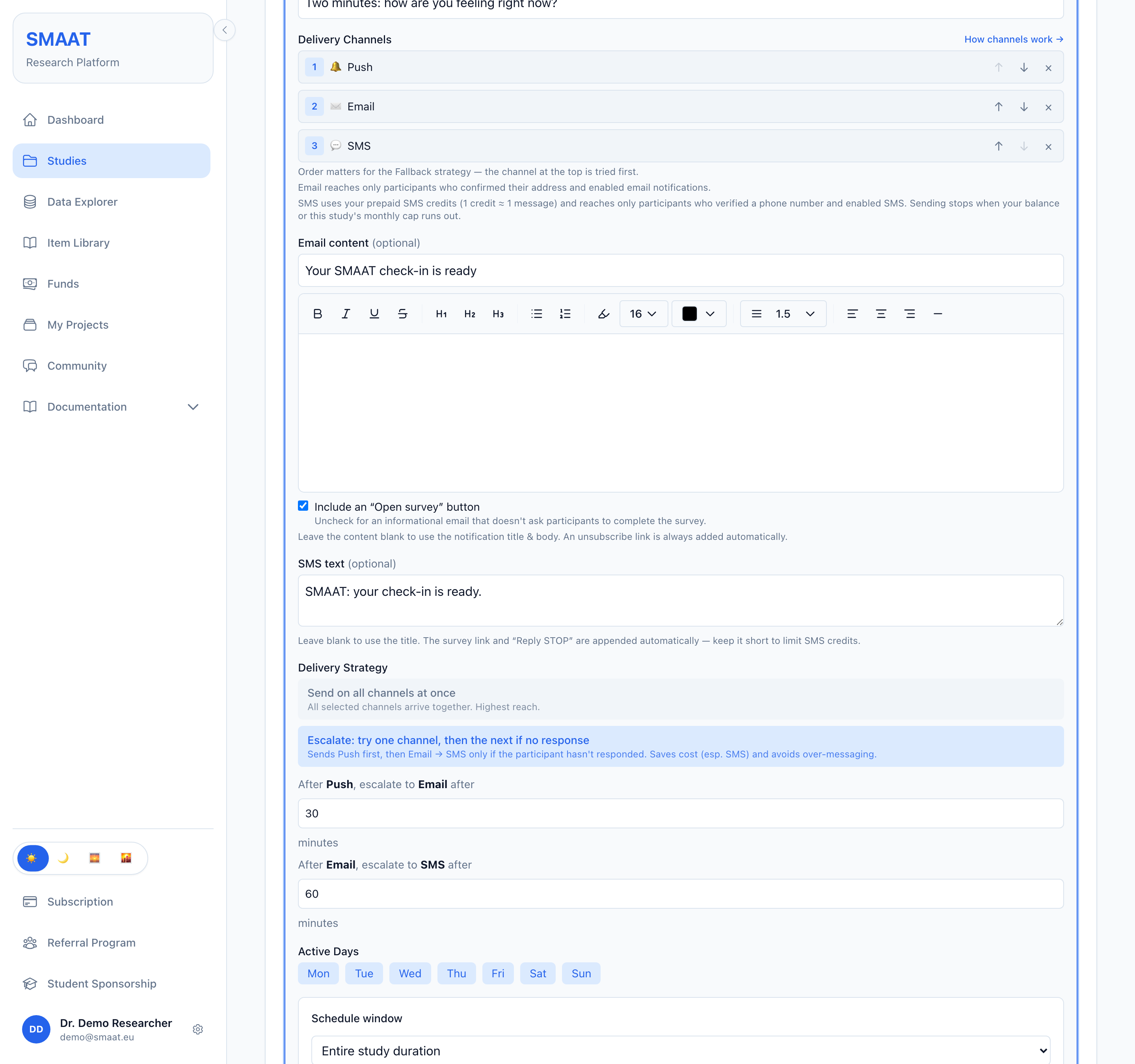
  • Delivery Channels lists the schedule's channels as numbered rows. The ↑ and ↓ buttons change the order, × removes a channel, and + Push, + Email and + SMS add one. At least one channel must remain. A new schedule starts with Push only. The How channels work → link opens this page.
  • Email content (optional) has a subject line, a formatted body and the checkbox Include an "Open survey" button. Unchecking it produces an informational email that does not ask for a survey. Blank fields use the notification title and body. An unsubscribe link is always added.
  • SMS text (optional) replaces the notification title as the text of the message. The survey link and the opt-out line are appended automatically. If the study has an SMS signature (Study Settings → Messaging; custom branding requires the Pro plan), it is appended as well.
  • Delivery Strategy appears when the schedule has two or more channels: Send on all channels at once or Escalate: try one channel, then the next if no response. With Escalate, one "escalate to … after … minutes" field appears for each gap between channels.
An expanded notification schedule in the Study Builder. The Delivery Channels list shows Push, Email and SMS as rows 1 to 3, Delivery Strategy is set to Escalate with two escalation-minute fields, and the Email content and SMS text fields are visible.
A schedule with the channels Push → Email → SMS, the Escalate strategy with its two waits, and the email and SMS content fields.
Schedules send nothing until the study is activated. Changes to a schedule are saved as a plan. Validate & Activate creates the notifications, and edits made later take effect after the study is activated again. Preview → Messaging → Push, Email or SMS shows how each channel's message will look. See Notification schedules.
Example

One participant's day

An illustration of how three schedules with different channel settings reach one participant.

09:00 · morning
Push The morning survey arrives as a push notification. The participant opens it and completes the survey, so no further channel is used.
13:00 · midday
The midday push is not opened. After the 30-minute wait, escalation sends the same prompt by email.
20:00 · evening
SMS The end-of-day check-in schedule lists SMS first, so it arrives as a text message and uses credits.
23:00 · night
Quiet time No messages. The participant entered 22:00 to 07:00 as quiet time during prescreening, so no channel delivers in that period.
Participant control

Quiet time, opt-in, opt-out and spending limits

Quiet time

Defined in Participants → Prescreening → Quiet Time. Participants enter daily times, weekdays or calendar dates during onboarding, and no channel delivers in those periods, evaluated in the participant's own time zone. Without this section there is no quiet time.

Opt-in per study

Email and SMS reach only participants who enabled the channel for the study and verified the email address or phone number in the app.

Opting out

Every email contains an unsubscribe link. With the default one-way SMS sender, each SMS ends with "Opt out in the app.", and participants turn SMS off for the study in the app. A sender that accepts replies uses "Reply STOP to opt out." instead.

Spending limits

SMS sending stops when the credit balance or the study's monthly SMS cap is used up. Push and email are not affected.

SMS credits

SMS is paid from prepaid credits

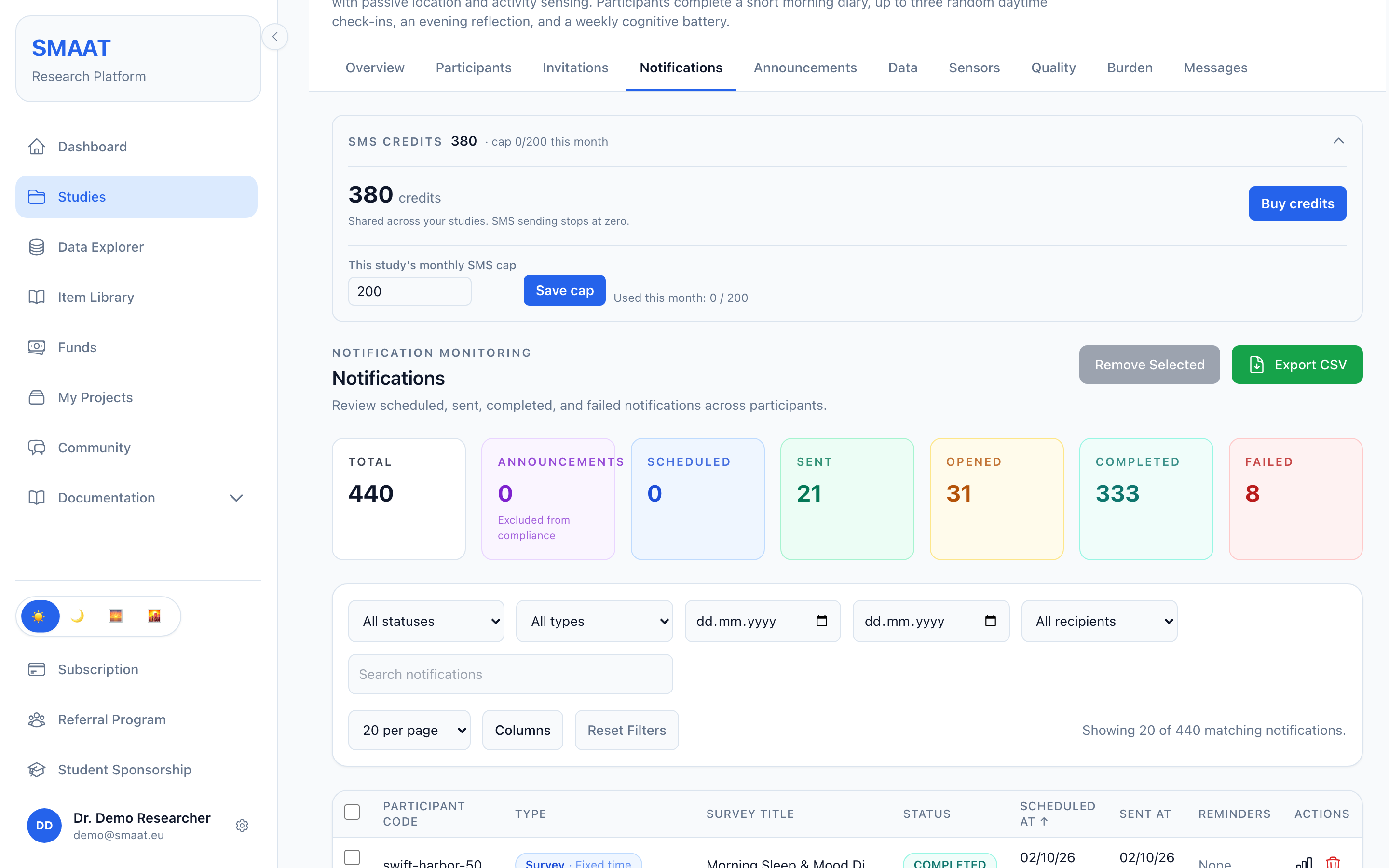
Each SMS costs credits from a prepaid balance that is shared by all studies of the researcher's account. Sending stops when the balance reaches zero, and there is no post-paid billing.

The study Notifications page with the SMS credits panel expanded, showing the shared credit balance, a Buy credits link, and the field This study's monthly SMS cap with a Save cap button.
The SMS credits panel on the study Notifications page: balance, Buy credits link and the monthly cap for this study.
  • 1 credit = 1 SMS segment
    A segment is one part of a text message. It holds up to 160 characters of the standard GSM-7 alphabet, or 70 characters if the text contains other characters such as emoji or typographic (curly) quotes. Longer messages are split into parts of 153 or 67 characters, and each part costs one credit. German umlauts and most Western European accents belong to GSM-7.
  • The link and opt-out line count
    The survey link, the opt-out line and any SMS signature are part of the message and are counted. The cost is calculated for each recipient's actual message.
  • Monthly cap per study
    The study's Notifications page has an SMS credits panel with the field This study's monthly SMS cap (empty means No cap) and Save cap. When the cap or the balance is reached, the remaining recipients of a prompt receive no SMS. The cap resets each calendar month.
  • Buying credits
    Buy credits opens the Funds page, where credits are bought in packs of 100, 500 or 2,000 (€20, €90 or €320) or converted from the payout wallet. See Account, security and billing.
Putting it together

The researcher's workflow in four steps

1

Write the prompt

Enter the Schedule Name, Notification Title and Notification Body.

2

Choose channels and strategy

Add and order the channels, fill in the email and SMS content, and choose a Delivery Strategy.

Push SMS
3

Validate & Activate

Activation turns the schedules into notifications for enrolled participants and for everyone who joins later.

4

Check delivery

On the study Notifications page, each notification's delivery details show its status, channels, strategy, the send outcome per channel and the channel the participant responded through (last touch).

Summary

Six points

1

Channels are set per schedule. Push, email and SMS can be combined in any order, with at least one channel.

2

Two strategies. All channels at once, or escalation to the next channel while the prompt is neither opened nor completed.

3

Email and SMS need opt-in. Participants verify the contact detail and enable the channel for the study.

4

Quiet time covers all channels. It applies when the study uses the Quiet Time section of prescreening.

5

SMS costs 1 credit per segment. The balance is shared across studies, and each study can have a monthly cap.

6

Nothing is sent before activation. Schedules take effect with Validate & Activate.

SMAAT · Notification Channels · © 2026 SMAAT Platform